ADHD in Children vs Adults: How It Appears and How Diagnosis Differs
Feb 22, 2026

ADHD in Children vs Adults: How It Appears and How Diagnosis Differs
ADHD looks different in children and adults. While the core traits are the same, inattention, hyperactivity, and impulsivity, how those traits show up in everyday life changes with age.
Understanding these differences can help parents, adults, and professionals recognise when a structured ADHD assessment may be helpful.
This guide explains:
How ADHD presents in children
How ADHD presents in adults
The key differences in diagnosis
Why age-appropriate assessment matters
The Core Features of ADHD
At any age, ADHD involves ongoing patterns of:
Difficulty sustaining attention
Impulsivity
Restlessness or hyperactivity
For a diagnosis to be made, these traits must:
Have started in childhood
Be present across more than one setting
Cause meaningful impact in daily life
However, what “impact” looks like is very different for a seven-year-old compared to a 35-year-old.
How ADHD Presents in Children
In children, ADHD is often more noticeable because behaviour tends to be more visible.
Common Signs of ADHD in Children
Inattention
Struggling to follow instructions
Making careless mistakes
Losing school materials
Appearing distracted or daydreaming
Hyperactivity
Constant fidgeting
Leaving their seat frequently
Running or climbing excessively
Difficulty staying still
Impulsivity
Interrupting others
Blurting out answers
Struggling to wait their turn
ADHD symptoms are often first noticed at school, where structure and expectations highlight difficulties.
Emotional and Social Impact in Children
Beyond behaviour, children with ADHD may also experience:
Frustration or emotional outbursts
Low confidence
Difficulty maintaining friendships
Academic performance below expected ability
Importantly, ADHD cannot be diagnosed based on school behaviour alone. Symptoms must also be present in other settings, such as at home.
How ADHD Presents in Adults
ADHD does not disappear at adulthood. For many individuals, it continues, but it often looks less outwardly hyperactive and more internally disruptive.
Common Signs of ADHD in Adults
Inattention
Chronic disorganisation
Difficulty finishing tasks
Forgetting appointments
Struggling with time management
Hyperactivity
Inner restlessness
Feeling unable to fully relax
Talking excessively in some settings
Impulsivity
Impulsive purchases
Interrupting in meetings
Making quick decisions without thinking through consequences
In adults, the hyperactivity is often internal rather than physical.
Why Adult ADHD Is Often Missed
Many adults were never assessed in childhood. Reasons include:
Less awareness historically
Symptoms attributed to personality traits
Strong academic ability masking difficulties
Developing coping strategies that hide challenges
Some adults only consider assessment after their child is diagnosed and they recognise similar patterns in themselves.
ADHD Symptoms in Children vs Adults: A Practical Comparison
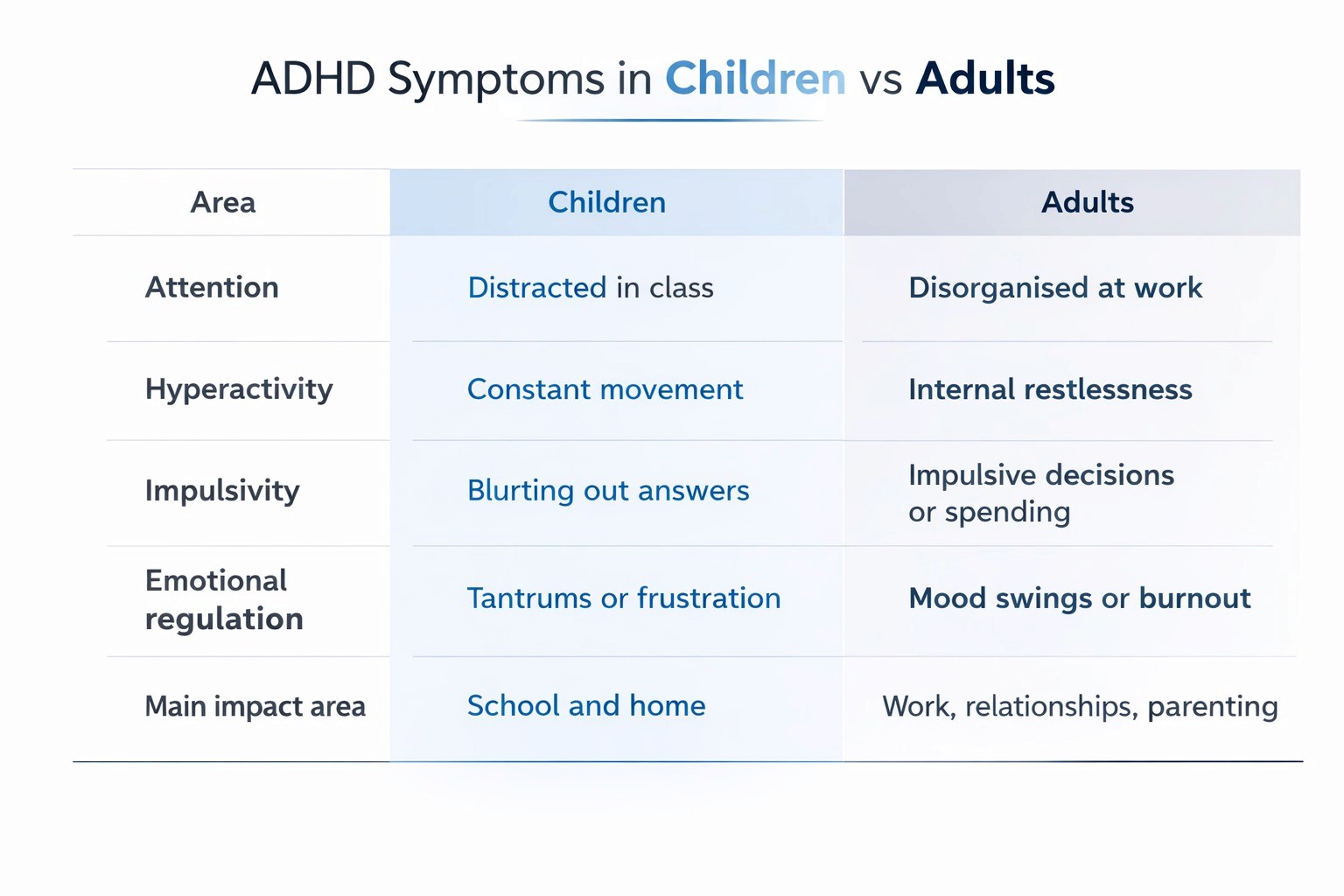
This difference in presentation is one reason why assessment must be tailored to age and life stage.
How ADHD Diagnosis Differs in Children and Adults
The diagnostic criteria are consistent across age groups. However, the way assessment is carried out changes.
Child ADHD Diagnosis Process
Assessment for children usually includes:
A detailed developmental history
Parent interviews
Teacher feedback or school reports
Standardised questionnaires
Direct clinical assessment
Screening for related conditions such as learning difficulties or autism
Safeguarding and risk considerations
The focus is on understanding development, behaviour across settings, and functional impact.
Adult ADHD Diagnosis
Adult ADHD diagnosis in the UK requires:
Evidence that symptoms began in childhood
Exploration of educational and occupational history
Assessment of current functioning
Screening for anxiety, depression, trauma, sleep difficulties, or substance use
Consideration of risk
Adults must show a lifelong pattern of symptoms, not just difficulties linked to stress or recent life events.
Key Differences Between Child and Adult Assessment
Sources of information
Children rely heavily on parent and school input. Adults rely more on personal history and retrospective evidence.Areas of impact
Children are assessed in terms of learning and development. Adults are assessed in terms of work, relationships, and daily functioning.Co-existing conditions
Adults are more likely to present with overlapping mental health conditions that require careful differentiation.
Masking Adults may have developed coping strategies that hide some symptoms, making structured assessment even more important.
Why Age-Appropriate ADHD Assessment Matters
A thorough ADHD assessment should never be reduced to a simple checklist.
High-quality assessment considers:
Developmental stage
Functional impact
Differential diagnosis
Risk and safeguarding
Clear documentation for next steps
Rushed or overly simplified assessments increase the risk of misdiagnosis or missed conditions.
ADHD is a lifelong condition for many people, but it does not look the same at every stage of life.
Children may show visible hyperactivity and classroom challenges. Adults may experience internal restlessness, executive dysfunction, and workplace strain.
Accurate diagnosis depends on structured, age-appropriate assessment that considers development, context, and co-existing conditions.
Understanding these differences helps ensure individuals receive the right support at the right time.
Frequently Asked Questions
Can a child grow out of ADHD?
Some visible symptoms, particularly hyperactivity, may reduce with age. However, many individuals continue to experience ADHD traits into adulthood.
Is adult ADHD a different condition?
No. The underlying condition is the same. The way it presents changes as responsibilities and environments change.
Why does adult ADHD diagnosis require childhood evidence?
Because ADHD is neurodevelopmental, symptoms must have been present from childhood, even if they were not formally recognised at the time.
Are ADHD assessments the same length for children and adults?
Both require comprehensive evaluation. The content differs, but a robust assessment at any age should not be rushed.