ADHD Assessment vs ADHD Screening: What’s the Difference?
Feb 22, 2026

ADHD Assessment vs ADHD Screening: What’s the Difference?
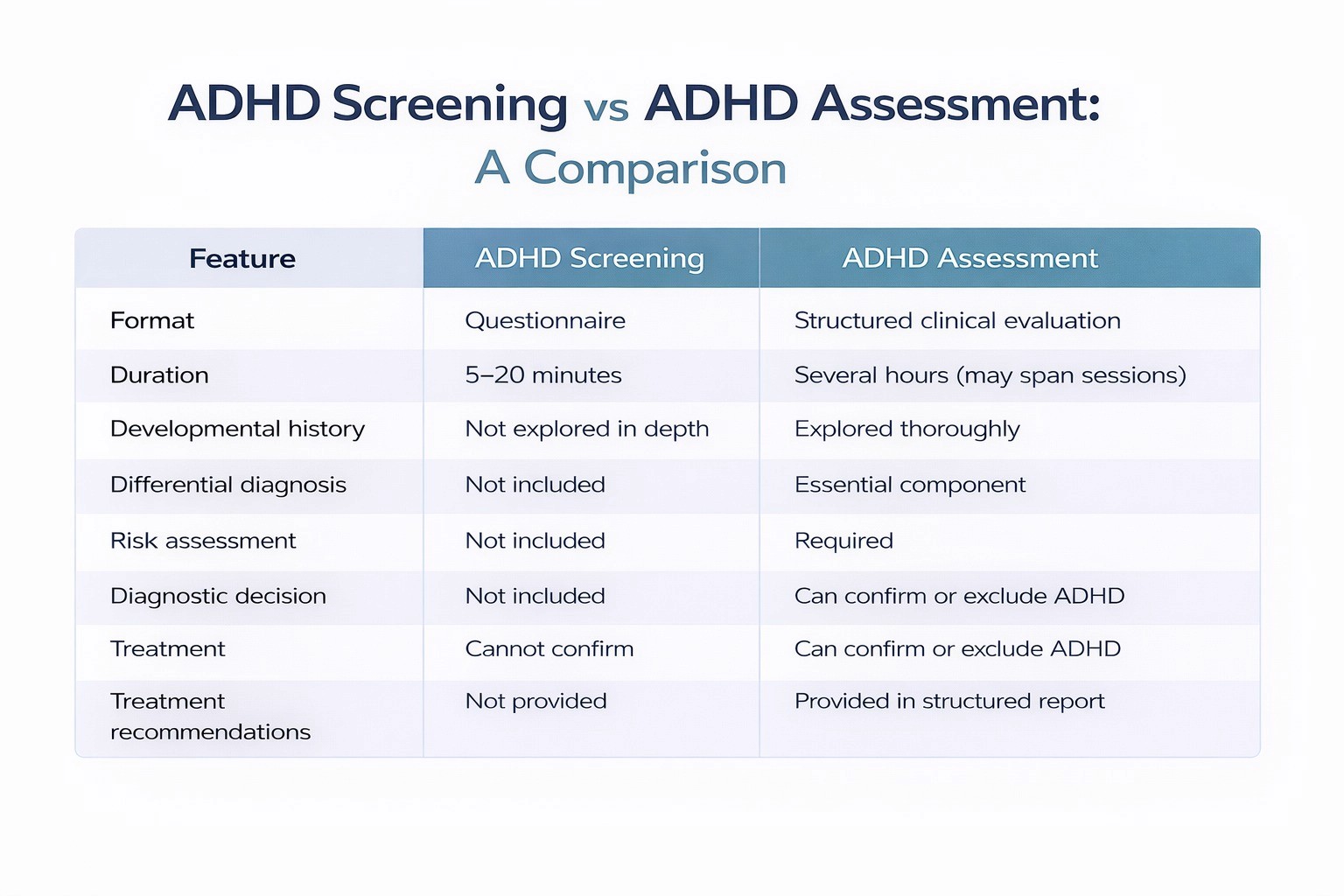
An ADHD screening tool is a questionnaire that indicates whether further evaluation may be helpful. An ADHD assessment is a structured clinical process that determines whether diagnostic criteria are met.
They are not the same thing.
Understanding the difference is essential for patients, parents, commissioners, and referring professionals.
What Is an ADHD Screening?
An ADHD screening typically involves a short questionnaire designed to identify symptoms associated with ADHD.
Examples include:
Self-report rating scales
Parent-completed forms
Teacher questionnaires
Online ADHD tests
Screening tools are useful for identifying patterns that may warrant further investigation.
However, screening tools:
Do not confirm diagnosis
Do not explore developmental history
Do not assess functional impairment in depth
Do not rule out alternative explanations
They are an initial signal, not a clinical decision.
What Is a Full ADHD Assessment?
A full ADHD assessment is a comprehensive clinical evaluation carried out by an appropriately qualified clinician.
It typically includes:
Structured clinical interview
Detailed developmental history
Exploration of functional impairment
Review of educational or occupational history
Differential diagnosis process
Screening for co-existing mental health conditions
Risk and safeguarding assessment
Clear documentation and treatment-ready recommendations
Diagnosis is based on recognised criteria such as DSM-5 or ICD-11 frameworks.
Can ADHD Be Diagnosed From a Questionnaire Alone?
No.
Questionnaires support assessment, but they do not replace clinical judgement.
A diagnosis requires:
Evidence of childhood onset
Persistent symptoms
Functional impairment
Consideration of alternative explanations
A checklist alone cannot provide this level of evaluation.
Why the Difference Matters
The distinction between ADHD screening and ADHD assessment is not semantic. It directly impacts patient safety and treatment decisions.
Misunderstanding the difference can lead to:
Inappropriate prescribing
Missed co-existing conditions
Failure to identify trauma-related or anxiety-related presentations
Incomplete documentation for shared-care arrangements
A high-quality ADHD diagnosis process in the UK requires structured evaluation, not just symptom scoring. Screening identifies possibility. Assessment confirms diagnosis.
What About Online ADHD Tests?
Online ADHD tests are typically screening tools.
They can:
Raise awareness
Encourage individuals to seek further evaluation
They cannot:
Confirm diagnosis
Replace structured clinical assessment
Provide treatment-ready documentation
Online tools should be viewed as a starting point, not an endpoint.
When Is Screening Appropriate?
Screening is helpful:
In primary care as an initial filter
In schools to identify possible need for referral
As part of triage within ADHD services
For self-reflection prior to seeking assessment
It is not sufficient for diagnostic decision-making.
What Does a High-Quality ADHD Assessment Add Beyond Screening?
A comprehensive assessment:
Confirms or excludes ADHD with clear reasoning
Identifies co-existing conditions
Assesses safeguarding and risk
Produces documentation suitable for onward care
Supports safe prescribing decisions
Provides clarity for individuals and families
This depth is what differentiates clinical evaluation from symptom screening.
ADHD screening and ADHD assessment serve different purposes.
Screening identifies the possibility of ADHD.
Assessment determines whether diagnostic criteria are met and what next steps are appropriate.
For safe, accurate diagnosis, structured clinical evaluation is essential.
Frequently Asked Questions
Is an ADHD screening test enough for medication?
No. Medication decisions require formal diagnostic confirmation through structured clinical assessment.
Why do some services advertise “quick ADHD diagnosis”?
Speed does not necessarily indicate quality. Diagnosis requires developmental history, differential diagnosis, and risk assessment to ensure safe care.
Can screening tools ever be inaccurate?
Yes. Anxiety, depression, trauma, sleep disorders, and stress can produce symptoms that resemble ADHD. Without differential diagnosis, misinterpretation is possible.
How long should a proper ADHD assessment take?
A comprehensive ADHD assessment typically takes several hours and may be delivered across more than one appointment.